Bonner Systems
- Debussy: next generation TIRF
- Vivaldi-Primo
- Mahler: Spinning Disk Confocal
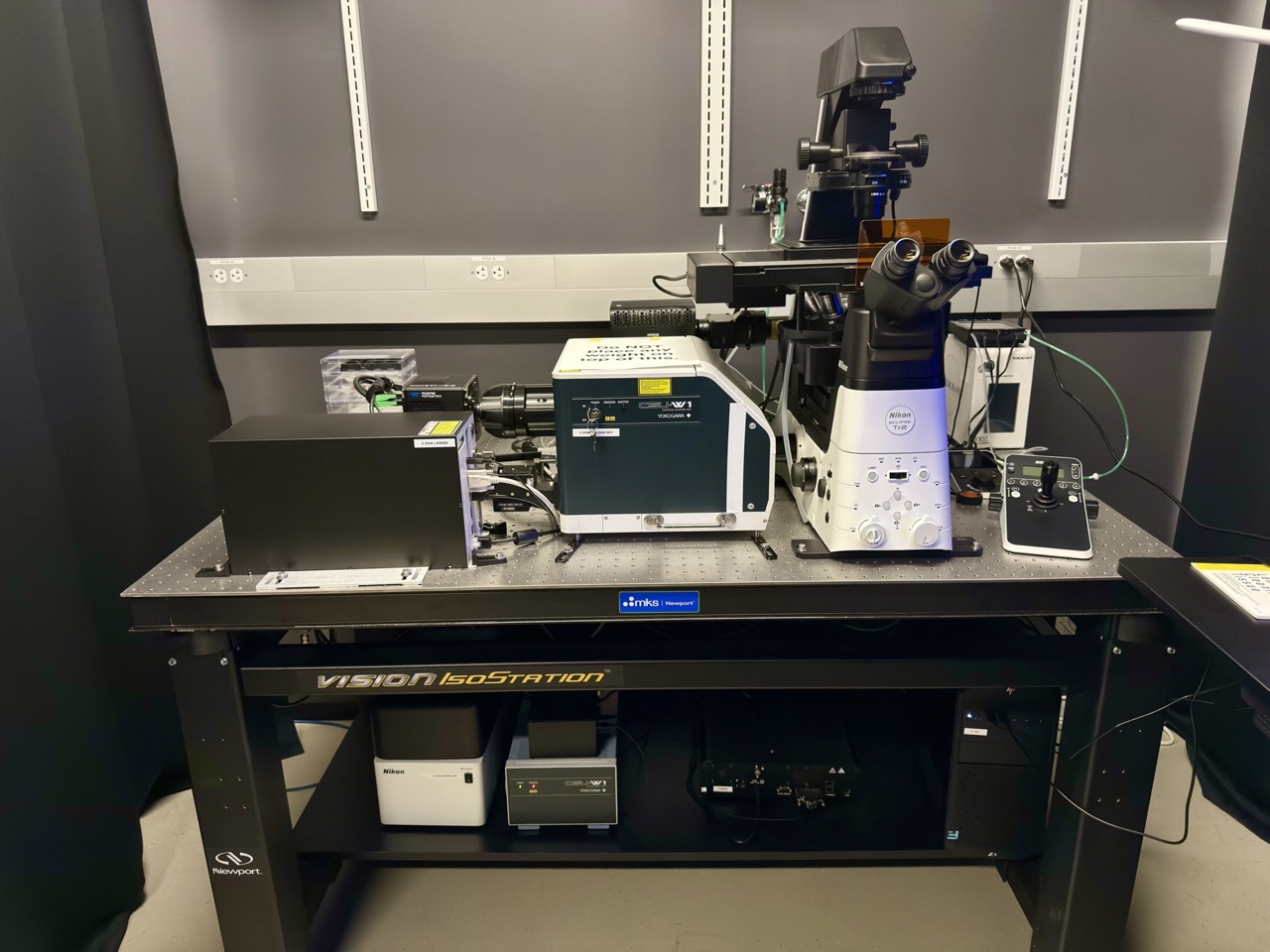
Mahler combines a Nikon Eclipse Ti2-E inverted microscope with a Yokogawa CSU-W1 spinning disk confocal scanner, a seven-line Lumencor ZIVA laser engine, and a Teledyne Photometrics Kinetix22 sCMOS camera. The system supports multicolor fluorescence imaging, optical sectioning, and time-lapse acquisition. A motorized XY stage, piezo Z drive, and Nikon Perfect Focus System support automated imaging, while a Tokai Hit stage top incubator provides environmental control for live cell experiments.
|
|
Specifications |
|||||||||||||||||||||||||||||||
|
Microscope body |
Nikon Eclipse Ti2-E, inverted and motorized |
|||||||||||||||||||||||||||||||
|
Stage |
Motorized XY stage |
|||||||||||||||||||||||||||||||
|
Piezo drive |
Queensgate (Prior Scientific) QGNPS083-NI piezo Z-stage with a 600 µm travel range and digital controller, supporting precise Z positioning for optical sectioning and Z-stack acquisition. |
|||||||||||||||||||||||||||||||
|
Perfect Focus System (PFS) |
Yes |
|||||||||||||||||||||||||||||||
|
Incubator |
Tokai Hit STX stage top incubator with temperature, CO2, and humidity control |
|||||||||||||||||||||||||||||||
|
Objectives |
Correction, Magnification, Numerical Aperture, Immersion, Working Distance |
|||||||||||||||||||||||||||||||
|
Plan Apo λD 4×, NA 0.20, air, WD 20,000 µm Plan Apo λD 10×, NA 0.45, air, WD 4,000 µm Plan Apo λD 20×, NA 0.80, air, WD 800 µm Plan Apo λD 40×, NA 0.95, air, WD 250 µm Plan Apo VC 60×A WI, NA 1.20, water, WD 310 µm Plan Apo λD 100× Oil, NA 1.45, oil, WD 130 µm |
||||||||||||||||||||||||||||||||
|
Confocal scanner |
Yokogawa CSU-W1 spinning disk confocal, single-camera configuration |
|||||||||||||||||||||||||||||||
|
Laser source |
Lumencor ZIVA 7-NII-CA laser engine: 405, 446, 488, 518, 577, 639, and 748 nm. USB control and TTL triggering via a National Instruments PCIe-6323 card synchronize laser illumination with camera acquisition. |
|||||||||||||||||||||||||||||||
|
Detector |
Teledyne Photometrics Kinetix22 Interface: PCIe Sensor technology: Back-illuminated sCMOS Resolution: 2400 × 2400 pixels Pixel size: 6.5 × 6.5 µm Sensor diagonal: 22 mm |
|||||||||||||||||||||||||||||||
|
Fluorescence channels and emission filters |
Draft channel assignments: excitation and emission pairings require verification in NIS-Elements before publication.
Single-band emission filters are listed as center wavelength/bandwidth. Penta and Triple multiband emission filters are listed as wavelength ranges in nm, as displayed in NIS-Elements. Channel names follow the NIS-Elements presets; excitation settings depend on the optical configuration. |
|||||||||||||||||||||||||||||||
|
Transmitted light |
Brightfield and DIC; long working distance condenser, NA 0.52 |
|||||||||||||||||||||||||||||||
|
Software |
NIS-Elements AR 6.20.02 |
|||||||||||||||||||||||||||||||
Bonner Hall 1407 (Sandbox)